
Contact & bookings
+34 683 31 71 92
info@mallorcapremiumtours.com
Follow us

Official Balearic Islands tour guides, organizing private tours and tailor-made guided visits across Mallorca for over 10 years.
As certified local guides, we design exclusive experiences that combine historical accuracy, personal attention, and a completely bespoke approach.

Mallorca is the largest island of the Balearic archipelago, a Mediterranean gem that hides a rich history, countless monuments, legends, traditions and an endless variety of things to do.
Discover the island of Mallorca with our official guides and exclusive tours, led by local experts.
Below you will find some ideas and inspiration on what to see and do in Mallorca.
If you come to Mallorca, you simply cannot miss the charming village of Valldemossa, set in a unique natural and cultural environment. Built over an ancient Islamic farmstead more than nine centuries ago.
You will find beautiful ceramic tiles on doorways and façades that guide you to the house where Saint Catalina Thomàs i Gallard was born, patron saint of Valldemossa.
You can also visit the palace of King Sancho of Mallorca, which was later transformed into the Royal Carthusian Monastery of Valldemossa.
Inside, you can explore the monks’ cells of the Carthusian Order of Saint Bruno, which from the 19th century onwards were adapted into private residences that welcomed some of the first foreign travellers to the island, including Frédéric Chopin and his partner George Sand, as well as Archduke Ludwig Salvator.
Visiting the town of Sóller is like travelling back in time. Its name comes from the Arabic sulliar, meaning “golden basin”, a very fitting name for the valley of orange groves that surrounds it.
Wandering through its streets, built with local limestone, you will discover traditional Mallorcan architecture and French-influenced palaces living side by side with modernist buildings such as the neo-Gothic church of Sant Bartomeu and the historic Bank of Sóller.
Don’t miss the original wooden train and tram, operating for more than a century, which connects this corner of the island with the city of Palma.
In a privileged enclave of the Serra de Tramuntana, halfway between Valldemossa and Sóller, lies the beautiful village of Deià. A magical place surrounded by terraced hillsides and stone houses.
If you walk up to the parish church of Saint John the Baptist, just behind it you will find the cemetery where many painters, musicians and poets who lived in Deià during the 1960s and 70s are buried, including the famous British writer Robert Graves, whose house and grave can still be visited today.
What truly makes Deià special is its location, high above the village, offering breathtaking views over the Mediterranean Sea.
If there is a sacred place for cycling enthusiasts, it is Sa Calobra. The road leading there is considered one of the most iconic cycling routes in the world.
An unforgettable 9.5 km climb that challenges even experienced cyclists and inspires many others to add it to their personal achievements.
Sa Calobra is also a perfect place to relax during the low season, enjoying a crystal-clear beach surrounded by dramatic mountains.
At its end lies the Torrent de Pareis, whose mouth forms the deepest canyon in Europe. Many hikers walk along the torrent during the months of low rainfall.
The Sanctuary of Lluc is a place of pilgrimage and an important spiritual centre in Mallorca, founded at the beginning of the 13th century. Its name comes from the Roman term given to the natural area where it is located: Lucus, meaning “sacred forest”.
The Virgin of Lluc, patron saint of Mallorca, is linked to the legend of a shepherd who discovered her image in the mountains while tending his flock.
After repeatedly returning the image to the local parish, it mysteriously reappeared at the discovery site, which was interpreted as a sign that the Virgin wished to remain there. A small chapel was then built on the spot.
Discover the town of Alcúdia, with more than 2,000 years of history. In 123 BC, the Roman consul Quintus Caecilius Metellus incorporated Mallorca into the Roman Republic, founding the cities of Palma and Pollentia.
During Muslim rule, Alcúdia was a farmhouse, and after the Christian conquest it became a fortified city, especially during the reign of Jaume II, when its medieval walls were built to protect the urban centre.
You can stroll along the walls and admire the beauty of this medieval city, declared a Historic-Artistic Site.
Nearby, you can also enjoy Alcúdia’s beach, perfect for families, with shaded areas under pine trees and fine sand. From here you can see the Alcúdia lighthouse, built in the 19th century.
Walking through the town of Pollença is like travelling through more than ten centuries of history. The name is believed to come from Al-Bulansa during Islamic times, and from the Roman city of Pollentia, although today it belongs to the municipality of Alcúdia.
Founded in 1229, this medieval town showcases a rich cultural heritage, including the Roman bridge, the parish church of Our Lady of the Angels, the Calvary steps and tower, among many others.
You will also enjoy the stunning surrounding landscape, framed by the Serra de Tramuntana mountains and the coastline, which is the longest on the island of Mallorca.
Cape Formentor is a privileged and inspiring enclave, one of the most iconic natural spots in Mallorca. Its dramatic cliffs have inspired countless artists who have found here a refuge for creativity and contemplation.
The cape rises over 100 metres above sea level, offering spectacular panoramic views.
Besides its viewpoints and stunning coves — such as Cala Figuera and Cala Murta — a visit to the Formentor Lighthouse is highly recommended. Nearby villages such as Pollença, Alcúdia and Deià are also worth exploring.
Far from mass tourism, the town of Artà has preserved the traditions of a welcoming village with a strong Mediterranean identity.
You can stroll through its cobbled streets, visit the main square and the Sanctuary of Sant Salvador, a medieval building from the 14th century (restored in the 17th century), located at the top of Puig de Sant Salvador, 509 metres above sea level, offering spectacular views.
Just 900 metres away you will find the Talayotic settlement of Ses Païsses, one of the most important and best-preserved archaeological sites in the Balearic Islands.
Finally, only 12 km away, you can visit the impressive Caves of Artà, located on the coast.
If there is one market you should not miss in Mallorca, it is the Sineu market. Every Wednesday from 8:00 am to 1:30 pm you will find all kinds of local products: fruit, vegetables, cheese, olive oil, wine, sobrassada, olives… as well as a traditional livestock market.
Beyond the market, Sineu boasts a well-preserved medieval ensemble that once hosted the palace of the kings of the independent Kingdom of Mallorca.
Highlights include its historic houses, the parish church of Santa Maria de Sineu and the traditional windmills that recall the town’s agricultural past.
In Binissalem you will find remains from Talayotic, Roman and Islamic periods, reflected in its wells, canals and place names.
During the 18th and early 19th centuries, Binissalem developed a consolidated historic centre, with notable buildings such as Can Marc, Can Beltran, Can Garrover, Can Bassa, Can Novell, Can Corneta and Can Tiró de ses Belles.
Considered the capital of Mallorca’s wine region, Binissalem was the first area to receive the Denomination of Origin (DO) in 1991. It is an excellent place to discover and taste local wines at its different wineries.
Contact & bookings
+34 683 31 71 92
info@mallorcapremiumtours.com
Follow us
Discover Palma de Mallorca with our private guided tours through the old town.
Take a walk and discover the history of the city of Palma de Mallorca. With our guided tours you can learn about the history of the old town of Palma along with its curiosities, anecdotes and magical corners that will make your visit to Palma a unique experience.
Our guided tours are designed to discover Palma in a private way, without crowds and at your own pace. We adapt to your tastes.
With Mallorca Premium Tours you can dWith Mallorca Premium Tours you can design your own route or let yourself be guided by our official local guides to create the perfect guided tour for you and your companions.
In addition to guided tours of the old town of Palma de Mallorca, we can advise you on other activities to do in some of the most beautiful villages of the Serra de Tramuntana such as Valldemossa, Sóller and Deià or even get to Artà, a small village in the east of Mallorca and visit its magnificent caves, a wonder of nature.
An example of a private guided tour could be the main area of the old town, also known as ‘Palma Monumental’.
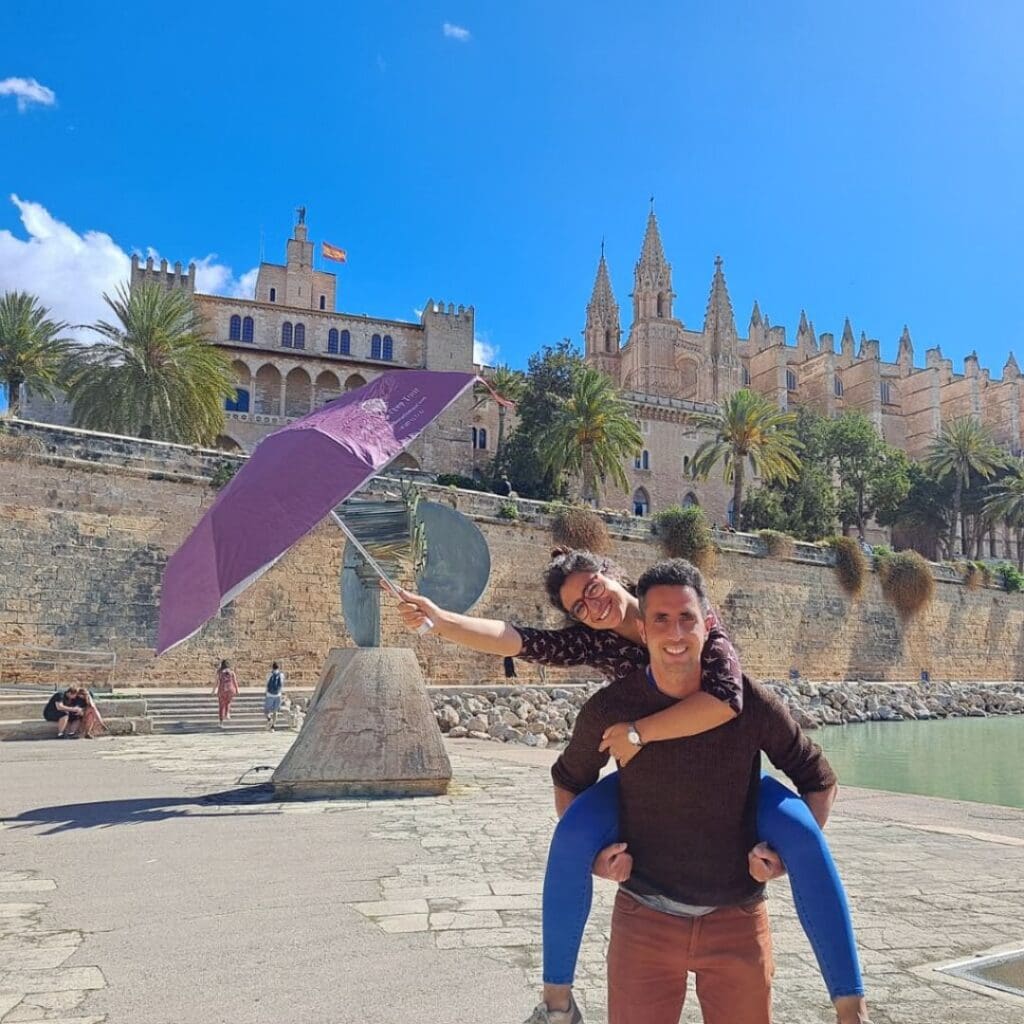
On this private tour, you will discover the most emblematic historical buildings in the city of Palma de Mallorca, such as the Royal Palace of l’Almudaina.built during the Muslim period (10th century) and residence of governors and kings in Palma de Mallorca and of course the Cathedral of Mallorca, considered one of the most spectacular cathedrals in the Mediterranean Sea. In addition to strolling through squares, narrow streets and visiting the entrance to Palma City Hall where the giants are exhibited, the famous “Giants”.correfoc” of the Drac from na Coca. Without forgetting the modernist and historicist buildings that since the s. XX we find in Palma such as Can Forteza Rey and Can Corbellà respectively.
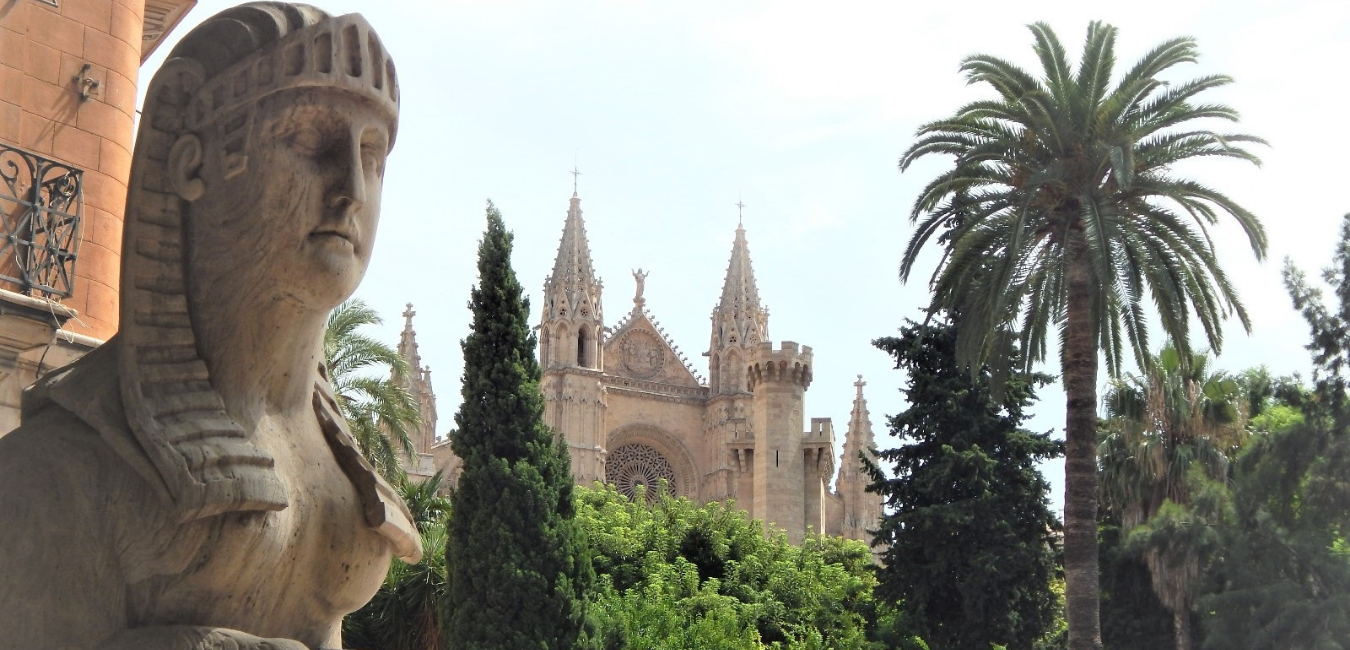
In this private tour we will show you the jewels of Palma de Mallorca: The Cathedral of Mallorca (also known as the Seu) built between the 13th and 17th century in Gothic style. Its location near the sea makes it the “Cathedral of the Sea”, the only cathedral reflected in the sea.
The other Gothic architectural marvel is the Bellver Castle. Built in the XIV century by Jaume II, fIt was conceived as a palace-fortress for Mallorcan royalty and strategically located to prevent future attacks. This castle has a circular floor plan and has been used as a residence, refuge in times of plague and revolts, military and civil prison and currently serves as a museum of the history of the city of Palma.
Valldemossa, a place of peace and tranquility. It is worthwhile to walk through its cobblestone streets and look at the entrances to the houses and businesses where we can find a small ceramic plaque with the image of the saint of Santa Catalina Tomàs. It is also essential to visit the Cartuja, a former royal palace from the 14th century, transformed into a Carthusian monastery in the 15th century and currently a museum; and taste its most exquisite sweet: the famous Coca de Patata.
Sóller attracts attention for its modernist buildings, built in the 20th century. highlighting the house-museum Can Prunera and the parish church of Sant Bartomeu. You cannot leave Sóller without having tasted the homemade ice cream and oranges, nor without having travelled on the famous Tren de Sóller, a wooden train inaugurated in 1912.