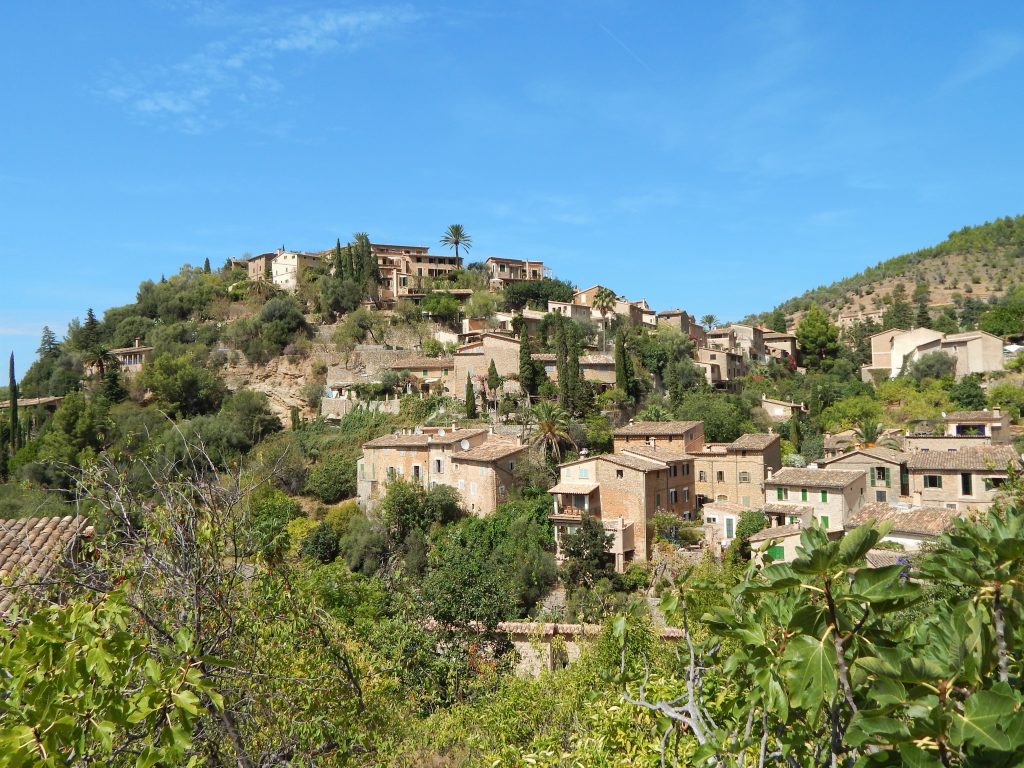
Valldemossa is probably one of the most beautiful villages in Mallorca.
The toponym Valldemossa has its origin in the tenth century, when troops in the service of the Emir of Cordoba and commanded by Issam Al-Khawlaní, conquered the islands and reorganized the territory 13 family clans called “juz”, giving rise to new names for the conquered lands. These “juz” were administrative districts comprising various tribal groups engaged in cattle raising. Almost all the “juz” had the same extension, except for Manacor (Manqur) and Monturi (Muntuy) which were much larger than the rest.)
This place was called Wadi Muza, or the valley of Musuh, Lord of these lands. This farmstead belonged to the ajka (pl. juz) of Bunyula-Musu. With the Christian conquest under the command of King Jaume I, this toponym was maintained and is credited to El Llibre de Repartiment. Thus, the farmhouse in the valley of Mussa, is the name that later became the current Valldemossa.
It is currently considered a UNESCO World Heritage Site since 2011. A village surrounded by olive, almond and carob trees where you can find the painted ceramics of Santa Catalina Tomàs in all the doorways of the houses and businesses with the phrase “Pray for us”; or taste the typical Coca de patata made with boiled potato, eggs, flour, oil, lard, sugar, yeast and powdered sugar.
THE CHARTERHOUSE OF VALLDEMOSSA:
The Cartoixa is the most emblematic building in the municipality.
In 1309, Jaume II, King of Mallorca, ordered the palace to be built on a hill called Es Pujol, in the same place where possibly the Moor Muza, lord of the valley, had his summer residence.
The third and last inhabitant of the palace was King Jaume III, nephew and heir of King Sanç. The palace was used during the hunting season and as a royal residence in summer. Later, after the Aragonese conquest in 1343, the palace fell into disuse due to its distance from the Aragonese court.
The history of the Charterhouse begins when the king of Aragon, Martin the Humane, protector of the Carthusian monks, an order founded by St. Bruno, ceded the palace of King Sancho to these monks in 1399, so that the Charterhouse could be founded.
The first step was to adapt the royal palace to a convent; the prison became a refectory (a common dining room for convents, monasteries and some colleges); the church occupied the palace kitchen; the parade ground was transformed into a cemetery; a cloister was built around it. The new work was carried out between the XVI-XVII centuries with the construction of the cloister of Santa Maria, with its cells, the chapter house and the hell or rooms destined to the women relatives of the friars.
The disentailment of the liberal government in 1821 put the monastery and the convent up for sale. The Carthusian monastery was divided into 47 parts, 27 of which were classified as houses. When the absolutist government was reestablished in 1823, it revoked the previous order and the church property returned to its owners. On the death of Ferdinand VII, the disentailment process was restarted. Once the monks were expelled by the law of the minister Mendizábal 1835 and the subsequent public auction, the project was extinguished, leaving the works half finished.
After a few years, the Charterhouse was acquired at public auction by the banker Eliseu Canut, except for the church, the sacristy, the pharmacy and the chapter house, which became the property of the bishopric. The residential Carthusian monastery was born, where cells were rented to visitors.
Years later, with the arrival of tourism, the whole of the Charterhouse became a museum operated by a civil society of owners. Today, the Charterhouse is divided into 9 parts. Frédérick Chopin and Aurore Dupin(George Sand) lived in one of its cells during the cold Valldemosyn winter of 1838 to 1839.