WHAT TO SEE IN PALMA DE MALLORCA
Let’s talk about typical places and emblems of Mallorca. Just like you can’t travel to Paris and not visit the Eiffel Tower. Or go to New York and not get to the Statue of Liberty, or fly to Rome and not see the Colosseum, you can’t visit Palma de Mallorca without missing these buildings.
In this post we will not tell you secrets about Palma de Mallorca, but we will give you that list of “Must”, those touristic places, thosemonuments of interest and emblematic points, that you cannot miss in your visit to Mallorca and the city of Palma.

What to visit in Palma - The Cathedral of Mallorca
If we had to choose an emblem of Mallorca, this would be the Cathedral, which looks splendid near the sea and the walls of the city of Palma and therefore deserves a visit and contemplate it quietly … unhurried.
We are proud to have in Palma de Mallorca this bastion of Gothic art in its maximum expression.
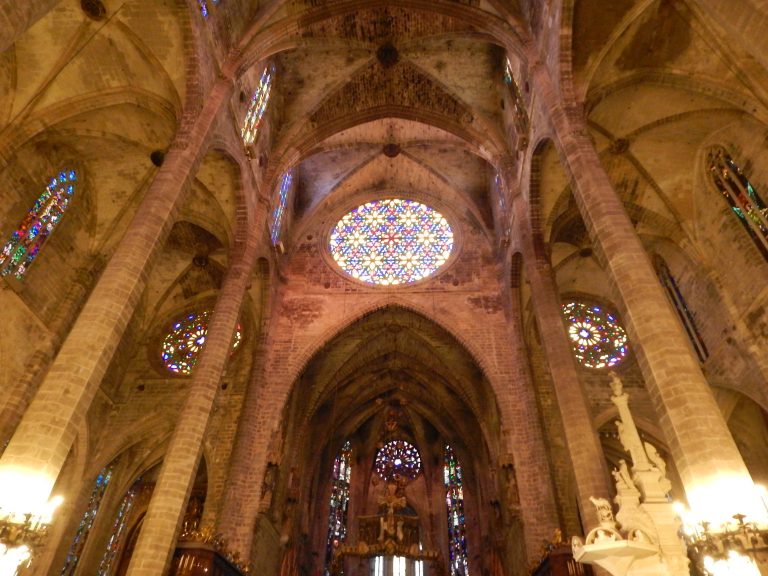
The Cathedral of Palma de Mallorca is one of the most beautiful Gothic cathedrals in the world and unique for its exceptional location by the sea: “a historic window with a view and reflection of the sea”.
It is worth a visit for its grandeur, space and light. Its main rose window, located in the apse, is among the largest in Europe. And with it occur some light phenomena worthy of being contemplated and of course photographed: on February 2 and November 11 takes place the“Festival of Light“.
The central nave is the third tallest in the world at 43.74 meters and the side naves are the tallest in the world at 30.17 meters.
We must also point out the last two interventions carried out inside the cathedral: that of 1904-1914 by Antoni Gaudí, whose baldachin, for example, is hypnotic. And the most recent intervention (in 2007) that incorporated contemporary elements never seen in other cathedrals: the mural created by Miquel Barceló in the Chapel of the Holy Sacrament.
Outside is also a marvel. Its reflection in the Parc de la Mar lake is impressive, both during the day and at night.
Where to go in Palma - Bellver Castle
Continuing with the emblems, a historical symbol of Mallorca is the Bellver Castle. Bellver CastleBellver Castle, of circular plan, practically unique and perfectly preserved, dominates the city of Palma, offering spectacular views of the city with the entire bay, part of the Serra de Tramuntana and the interior of the island.
Bellver Castle is one of the Gothic jewels of Mallorca. Fue mandado construir por Jaume II entre 1300 y 1311. Se proyectó inicialmente como residencia real, pero también ha sido utilizado como fortaleza, refugio en tiempos de plagas/enfermedades y revueltas sociales y prisión militar y política. Since 1976 it houses the Museum of History of Palma, where you can see the urban evolution and history of the city of Palma, and visit part of the collection of Greco-Roman sculpture of Cardinal Despuig.
Several famous people were confined in Bellver Castle: Gaspar Melchor Jovellanos, François Aragó, Arsenio Martinez Campos, Emili Darder, Alexandre Jaume and General Luis de Lacy.
This heritage is recommended to visit with children, as the castle looks like something out of a Middle Ages movie.
If you want to understand the history of Palma’s monuments, the best option is to explore them with a private walking tour led by an official guide.

Things to do in Palma - The Royal Palace of l'Almudaina
Situated in front of the Cathedral of Palma, the Palace of l’Almudaina is a construction of Muslim origin of the tenth century, and was the residence of the wali or Muslim governor.
Almudaina is an Arabic word, it is the diminutive of medina (city) and means “citadel”, but always with references to “fortress” or “walled enclosure”.
After the Christian conquest by Jaume I on December 31, 1229, the Muslim palace became the royal residence. Since the 13th century, the building has been renovated and enlarged on several occasions, leaving very few original remains.
Currently, you can visit half of the building, since part of the palace is the General Command of the Balearic Islands. During the visit the main halls, the parade ground, the chapel of Santa Ana and the original Arab baths from the Muslim period are visited.
L’Almudaina is the Royal Palace or Royal Alcazar of the city of Palma and is part of the National Heritage. The Royal Palace of l’Almudaina is the King’s official summer residence, although he lives in the Marivent Palace and only uses it for state ceremonies and receptions during the summer.
Finally, we recommend you to take a look at the angel on the highest tower of the building: the 3-meter sculpture of the Archangel Gabriel, known as the Guardian Angel. A weathervane sculpture that is very impressive when the wind blows.

Where to walk around Palma - La Lonja and the Consulado del Mar
The Lonja or Llotja of Palma is a masterpiece of civil Gothic architecture in Mallorca, its interior columns simulate a forest of palm trees, the floors are mirrors that reflect the details and outside is majestic … you can not stop contemplating.
La Llotja was built by Guillem Sagrera between 1420 and 1452, when Mallorca was an important maritime commercial center.
Located 5 minutes from the Cathedral, by the sea and the current port of Palma, it was the headquarters of the Merchants’ College, where they met to negotiate prices, conduct business transactions, business, etc.. In this scenario, one can imagine the merchants doing their business.
At the end of the 15th century and onwards, Mallorca suffered several economic and commercial crises, so Palma ceased to have so much commercial importance and the building was used for various purposes such as storage, gunpowder magazine and cannon factory. Currently the building can be visited and the exhibition is the architecture itself.
The Consulate of the Sea
Next to the Lonja is the Consulado del Mar. Since 1983 it has been the seat of the Government of the Balearic Islands.
The Consulate of the Sea was a very common medieval institution in port cities. It was linked to the law of the great merchants and the great commercial cities. Its functions were to regulate trade and maritime affairs in mercantile matters.
The current building is the product of several renovations. It was built in the XVI century. The main façade preserves a Plateresque loggia gallery with balustrade and five large arcades.


Mallorca Premium Tours – guided tours in Palma and Majorca