The Mills of Mallorca
When you are landing at the airport of Mallorca, the first thing that will catch your attention is the number of windmills waiting to welcome you. These windmills are for water extraction and since the mid-nineteenth century are part of the landscape of Mallorca, but there are more windmills to discover, and although of agricultural tradition, today they are part of a rich heritage and one of the most curious images of our island.
Today we explain you more about these endearing “giants” and do not hesitate to discover with us with us much more about the historical and scenic heritage of Mallorca with our cultural routes. Sign up now!
TYPES OF MILLS
Mills have been used since ancient times for agricultural purposes, mainly for grinding grain. These are machines that harness a type of energy (air, water, human or animal power) to convert it into rotational energy, moving a rigid body that rotates around a fixed axis. The first windmills, those using wind power, are believed to have appeared in Persia in the mid-7th century and reached Europe in the 10th century, although by the 12th century they were very popular throughout the continent.
Did you know that nowhere in the world is there such a concentration of windmills as in Mallorca? There are more than 3,000 windmills that since 2004 the Balearic Government and the Consell de Mallorca are trying to recover thanks to a restoration and conservation plan as they are a symbol of identity of our island. Don’t miss them!
WHEAT MILLS
In Mallorca there are already documented windmills for grinding flour before the Christian conquest and since the 14th century several windmills such as those in Levante and Poniente de Palma (Barrios del Molinar and el Jonquet) and in other areas of Mallorca, which today conserve part of their set, are even represented in paintings of the time.
Mallorcan mills are characterized by having 6 blades in the shape of a graella (cuadrícula) e inicialmente se construyó la torre circular sobre tierra, pero en el siglo XVII y hasta el siglo XIX empezó a generalizarse la construcción sobre una plataforma que servía también como vivienda. In the XVII century, with the increase in cereal production, the constitution of the professional guild and brotherhood in honor of San Lorenzo was promoted.
With the appearance of flour mills at the end of the 19th century and the technological change driven by new explosion and electric motors, these mills will begin a period of decline and abandonment until public institutions begin to take an interest in them, in their protection and restoration. Today there are 622 flour windmills in Mallorca.

WATER EXTRACTION MILLS
The first mills of this type came from the Dutch engineer Paul Bouvij in the mid-nineteenth century in a plan to drain the area now known as the Pla de Sant Jordi. Their mission was the extraction of groundwater from what was then a lagoon, and in the beginning they were very similar to the flour mills, with a base, circular tower, capital and between 6-8 blades.
Soon they will begin to be designed specifically for its function, placing wooden slats instead of blades and that as a fan, open and close, are known as ramell windmillsIn the 1870’s an arrowhead tail was incorporated to replace the manual rudder and allow the mill to automatically orient itself in order to take better advantage of the force of the wind.
In the 1930s, following the same operation as the previous ones, the well-known “molins de ferro” appeared. molins de ferrowhich substitute wood for steel and are built on a square base, are the most abundant today on our island. In the 1960s they began to be abandoned due to the replacement of engines and the decline of agriculture in the face of the incipient tourist industry and progressive salinization of groundwater.
Today there are about 2,300 of these mills distributed in the municipalities of Campos, Sa Pobla and Palma.
🌟 Private Walking Tour of Palma de Mallorca
Tour the old town, historic courtyards and the Cathedral with an official guide. A personalized experience ideal for culture lovers.
See details and book
BLOOD MILLS
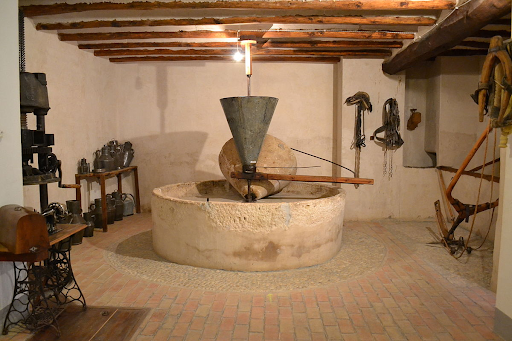
Unlike the previous mills, the blood mill is the one that moves thanks to animal power, generally in Mallorca by shallow (type of Majorcan donkey). They are generally found in the possesions (rustic farms for family use) and were mainly used to grind grain, although also other products or to produce oil, in this case they are called trujal. Although hundreds of mills are documented in historical references, there is no current inventory of this type of mills.
RESTAURANTS IN THE MILLS
Many of the windmills have adapted to the economic transformation of Mallorca and have used the old dwellings at their base to become restaurants, such as the charming Sa Farinera restaurant, next to the airport, which offers a familiar and traditional environment. Its specialty in grilled meats has made it one of the favorite restaurants of the locals for generations, or the Moli d’en Pau in Sineu, a village in the center of the island, which offers an exquisite menu of traditional and signature local gastronomy in an incomparable setting.
MUSEUM OF THE MILLS
Discover more secrets of the world of mills by visiting the Windmill Museum located in the emblematic neighborhood of the Jonquet, of seafaring tradition and spectacular views to the Bay of Palma. This museum offers guided tours on Mondays, Wednesdays and Fridays from 10:00 to 13:00 and is managed by the social foundation Amadip, which works for the labor inclusion of people with disabilities on the island.
Make an appointment at https://esmentguies.es/visitas/museu-dels-molins-moli-den-garleta/
Long live Los Molinos!

Mallorca Premium Tours – Private tours all over Mallorca
Follow us at